Commercial Door Access Control Systems: 7 Best Choices for 2026

Commercial Door Access Control Systems: 7 Best Choices for 2026
Most Ohio facility managers in 2026 are not asking whether to install commercial door access control systems, they are asking which platform survives the next five years of mergers, cloud-pricing changes, and cybersecurity audits. The wrong pick means ripping out hardware before it depreciates. The right pick fits the door, the IT stack, and the audit trail that insurance and HR both want.
Prime Door installs and supports commercial door hardware across Ohio. We work alongside the major access-control integrators on retrofit and new construction. The seven platforms below are what our clients actually deploy in 2026, where each one fits, and the trade-offs we walk every facility manager through before the hardware order goes out.
What “commercial door access control” actually covers
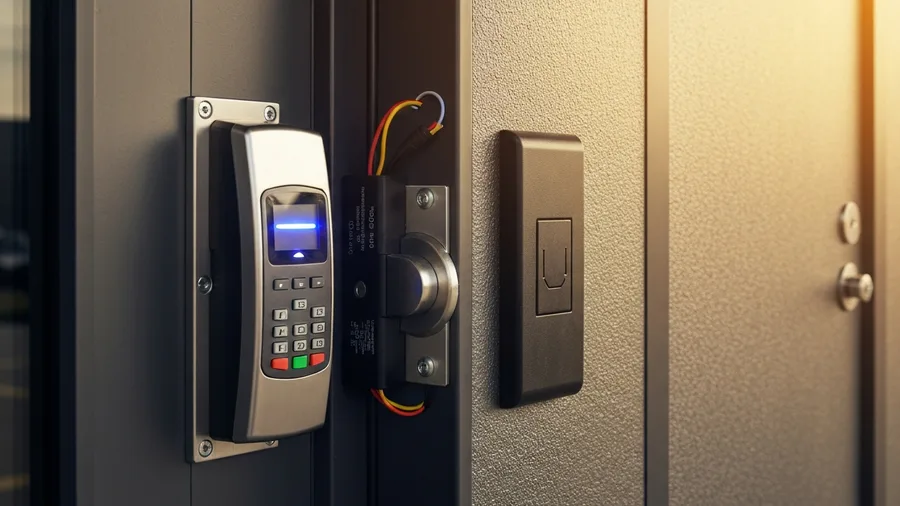
A modern access-control system has five layers, and the lock at the door is just one of them:
- Credential. Card, fob, PIN, mobile credential, or biometric. Most enterprise sites use two or more.
- Reader. The wall- or door-mounted device that reads the credential. OSDP (Open Supervised Device Protocol) is the 2026 standard, replacing legacy Wiegand.
- Controller / panel. The brain. Lives in a closet, talks to readers over wire or wireless, makes the lock decision.
- Locking hardware. Electric strike, electromagnetic lock, electrified mortise lock, electrified panic device, or smart lock.
- Management software. Where credentials are issued, schedules are set, and audit logs are read.
The decisions that matter most are usually the controller and software, because they determine your costs, integrations, and lock-in for years.
The 7 best commercial door access control systems for 2026
1. Genetec Security Center / Synergis
Genetec is the enterprise-grade choice for facilities that want a unified physical-security platform: access control, video, intrusion, ALPR, intercom, all on one server. The Synergis access-control module is one of the most flexible on the market, supporting nearly every reader and lock vendor. Pricing is per-door and per-server, and it climbs fast.
Best for: Large enterprise, multi-site, security-mature organizations.
Common reader and lock pairings: HID Signo readers, ASSA Abloy electrified locks, Aperio wireless locks.
2. Honeywell ProWatch / NetAXS
Honeywell’s installed base in industrial Ohio is large. ProWatch is the enterprise platform, NetAXS is the small to mid-site web-managed controller. Both integrate with Honeywell’s video, intrusion, and building automation lines, which matters when the same vendor wires the alarm and the HVAC.
Best for: Manufacturing plants and warehouses already standardized on Honeywell.
Common reader and lock pairings: Honeywell OmniAssure or HID readers, Securitron electromagnetic locks.
3. Lenel S2 NetBox / OnGuard
Lenel S2 (Carrier) competes head-to-head with Genetec for enterprise installs. OnGuard is the heavyweight platform, NetBox is the cloud-managed small to mid-site product. Common in education, healthcare, and government facilities.
Best for: Institutional facilities, hospitals, universities, government.
Common reader and lock pairings: HID Signo readers, Sargent Profile wireless locks, electrified Von Duprin panic devices.
4. Software House (Tyco) C-CURE 9000
C-CURE 9000 is the platform of choice for high-security facilities that also need PSIM (Physical Security Information Management) capabilities. It costs more and demands more skilled integrators, but it scales to tens of thousands of doors across continents.
Best for: Critical infrastructure, datacenters, large pharma, defense contractors.
Common reader and lock pairings: HID Signo, ASSA Abloy electrified locks, Aperio wireless.
5. Openpath / Avigilon Alta Access (Motorola)
Avigilon Alta Access (formerly Openpath, now Motorola-owned) is the cloud-native, mobile-credential-first platform that has reshaped small to mid-site access-control over the past five years. The reader is sleek, the mobile app is intuitive, and the cloud console is faster to deploy than any on-prem competitor.
Best for: Office buildings, mid-size manufacturers, multi-tenant industrial parks.
Common reader and lock pairings: Openpath proprietary reader, electric strike or electromagnetic lock at the door.
6. Brivo Access
Brivo is the longest-standing cloud-access-control vendor, with the broadest reader and integrator ecosystem. Smart-card or mobile credential, on-prem or cloud, single-site or multi-site. Pricing per-door per-month is competitive with Avigilon Alta.
Best for: Distributed operations, retail chains, multi-location facility managers who want one console.
Common reader and lock pairings: Allegion (Schlage), Brivo OnAir readers, ASSA Abloy locks.
7. Verkada Access Control
Verkada bundles access control, video, alarm, and environmental monitoring into a single cloud-managed platform with one admin console. For facilities that want one vendor for everything physical-security and are willing to accept the trade-offs of a fully cloud product, Verkada has rapidly grown in 2025 and 2026.
Best for: Mid-size single-vendor deployments, schools, small healthcare, retail.
Common reader and lock pairings: Verkada AC11 / AC41 readers, electric strikes, electromagnetic locks.
The locking hardware question: strike vs maglock vs electrified mortise
An access-control system needs a way to actually unlock the door. Four options, each with use cases:
- Electric strike — replaces the strike plate, allows the latch to release on signal. Cheapest, most common, works on most existing doors. Top brands: HES, Folger Adam, Adams Rite, Von Duprin.
- Electromagnetic lock (maglock) — holds the door closed with a magnet. 600 lb or 1200 lb holding force. Requires fail-safe wiring (releases on power loss) and request-to-exit hardware. Top brands: Securitron, ASSA Abloy, DynaLock.
- Electrified mortise / cylindrical lock — the existing lock is the locking point, with an electric solenoid inside. Cleanest install, most secure, most expensive. Top brands: Sargent, Schlage, Corbin Russwin, Yale.
- Electrified panic device — for exit doors. Electric latch retraction or electric dogging. Top brands: Von Duprin, Sargent, Detex, Precision.
For a deeper look at the lock options themselves, see our best commercial door locks guide.
How to choose: 5 questions before the contract
- Cloud, on-prem, or hybrid? Cloud is faster to deploy and cheaper for under 50 doors. On-prem is cheaper over five years at 100+ doors and survives an internet outage.
- Mobile credential strategy? Card-only is being phased out. Most 2026 deployments require at least mobile credential support.
- What other security systems will it integrate with? Video, intrusion, intercom, fire, visitor management. The fewer vendors, the simpler the support call.
- Who manages the system day to day? A small facility with no IT staff needs a managed-service vendor. A large enterprise with a security team can run on-prem.
- What is the cyber-hardening expectation? Access-control panels are network-connected. The U.S. CISA physical-access guidance, NIST SP 800-116, and IEC 62443 are the 2026 references.
The mistakes that wreck an access-control rollout
- Buying the panel before the door survey. Half of the doors in a typical retrofit need new hardware before the access-control can mount. Strike pocket reinforcement, hinge replacement, frame welding — all visible before the PO if a real survey happens.
- Forgetting the egress code. Every controlled door on a means of egress must satisfy NFPA 101 free-egress, with proper request-to-exit hardware. Maglocks especially need attention here.
- Skipping the fire-door interaction. Electrified hardware on a fire-rated door must be listed for that rating. Substituting a non-rated electric strike fails NFPA 80 the day the inspector walks the building.
- Underestimating the cabling cost. Running wire to every door in an existing building is often the largest line item, sometimes larger than the hardware itself.
- Not planning for failure modes. Fail-secure vs fail-safe, primary power vs backup, what happens to the lock when the panel reboots. Every door type and every code requires a specific choice.
Where Prime Door fits in
We are the hardware side of the access-control project: we field-measure your existing doors, recommend the strikes, maglocks, electrified locks, hinges, closers, and frames that work with the platform your integrator is installing, and we install them across Ohio with our own crews.
If you are planning an access-control upgrade in 2026 and want a door-and-hardware second opinion before the PO goes out, request a quote or call (330) 754-2225.