
Hospital Doors in Ohio: Healthcare Door Assemblies for Hospitals & Clinics
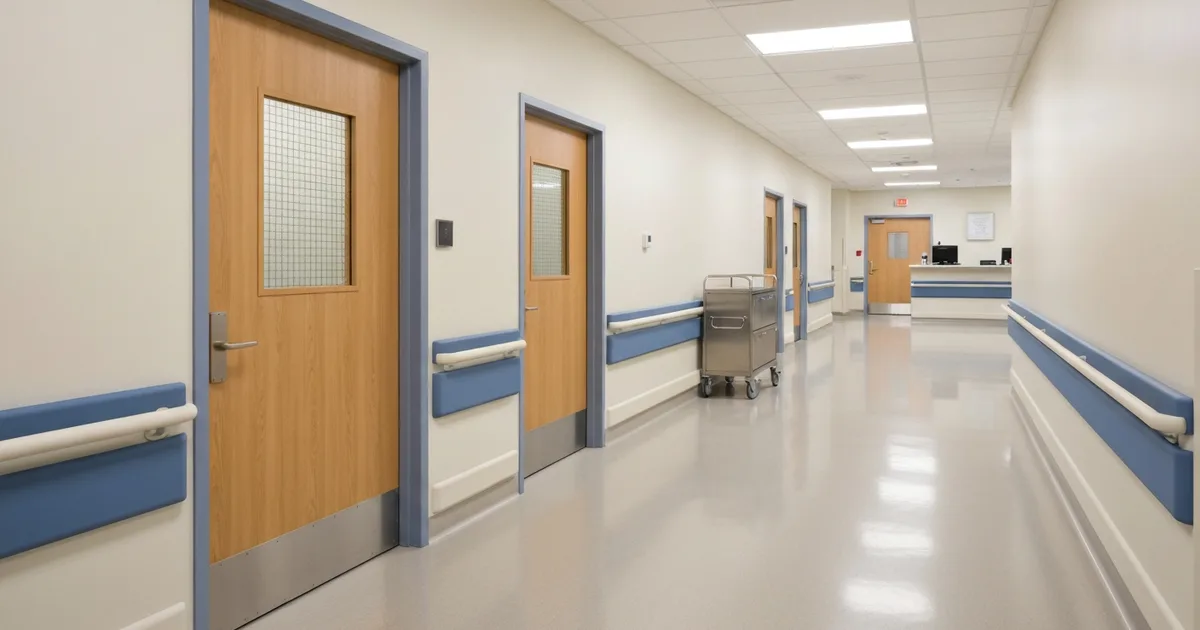
Healthcare facilities have door problems that other commercial buildings don’t. A hospital corridor door must maintain its fire rating for 90 minutes. An ICU sliding door has to seal a negative-pressure room and break away in an emergency. A behavioral-health door can’t have a single ligature point. When these openings fail, the cost is to patients, not just dollars.
Prime Door supplies and installs hospital doors across Ohio. We work with hospitals, surgery centers, outpatient clinics, behavioral-health facilities, dental practices, and long-term care campuses across the state, with our team based in Youngstown.
This page covers the seven door types Ohio healthcare facilities specify most often, the hardware that goes with each, the codes that govern them, and how to get an Ohio-installed assembly that passes inspection on the first try.
Quick action: Request a healthcare-door quote and we respond within 24 hours with sizing, fire-rating, and hardware suggestions tailored to your facility type. Or call (330) 754-2225 to talk to an estimator.
The 7 healthcare door types Ohio facilities specify most
1. Hospital corridor doors (hollow metal, fire-rated)
The most-installed door in any healthcare facility. Hospital corridor doors are typically 20-minute, 45-minute, or 90-minute fire-rated hollow metal assemblies with positive latching, smoke gaskets, and self-closing devices. They separate patient zones from utility, mechanical, and means-of-egress corridors per NFPA 101 Life Safety Code.
Common specs we install in Ohio hospitals:
- Steel face: 16- or 18-gauge cold-rolled or galvanized
- Core: honeycomb, polyurethane, or temperature-rise (for stairwells)
- Frame: knock-down or welded hollow metal, fully grouted in masonry walls
- Glazing: tempered or fire-rated ceramic vision lites
We pair these with LCN or Norton heavy-duty closers, continuous geared or ball-bearing hinges, and ANSI Grade 1 mortise locks. The hollow metal door page covers material trade-offs in more depth.
2. Patient room doors
Patient rooms have requirements other corridor doors don’t: acoustic isolation, impact resistance from rolling beds and meal carts, and aesthetics that read as residential rather than institutional. Typical patient-room specs:
- 1-3/4″ solid-core wood or hollow-metal-with-wood-laminate
- Sound transmission class (STC) 34–38 to support patient privacy and HIPAA conversations
- Push/pull hardware (no exposed lever) on bath access doors
- Privacy indicator hardware visible to nursing staff
- Heavy-duty kick plates and mid-rail bumpers, because a meal cart will hit it
Patients and visitors handle these doors thousands of times a year, so we recommend continuous geared hinges over butt hinges to prevent sag and frame damage.
3. ICU and OR sliding doors
Critical-care environments use automatic sliding or manual breakout doors so a clinical team can move equipment fast and keep a sterile field. The market is dominated by manufacturers like Stanley Access, Horton Automatics, and ASSA Abloy. Prime Door is your Ohio installer and service partner for these systems where projects call for them.
Key features specified for ICU and OR doors:
- Sealed perimeter with full-perimeter sweeps for negative- or positive-pressure rooms
- ICRA-compliant sliding tracks for infection control
- Hands-free wave switches or push-plate activation
- Optional lead-lined panels for hybrid OR or imaging suites
- Battery backup for life-safety power loss
If you have an automatic sliding door already installed and need replacement parts, calibration, or annual inspection, we can service the OEM equipment in addition to selling and installing new units.
4. Behavioral health and anti-ligature doors
Mental health, addiction-recovery, juvenile, and forensic units need doors with zero ligature attachment points. The door, frame, hinges, closer, lockset, and even the deadstop must be designed so nothing can support the weight of a patient. Failure here is a sentinel event.
What we supply for behavioral health:
- Anti-ligature continuous hinges (sloped to prevent attachment)
- Anti-ligature lever sets with mortise breakaway (CECO, Marks USA, or Sargent)
- Recessed pulls instead of grab bars
- Anti-barricade hardware that allows staff to reverse-open a barricaded room
- Tamper-resistant fasteners throughout
These doors are spec-driven by clinical risk assessment, so we coordinate with your facility manager and the Joint Commission ligature-risk team to confirm each opening is correct.
5. Lead-lined doors (radiology, imaging, dental, oncology)
Any room with X-ray, CT, fluoroscopy, mammography, dental imaging, or linear accelerator equipment needs lead-lined door assemblies to contain ionizing radiation, typically 1/16″ to 1/4″ lead equivalency per the radiation physics report.
Prime Door supplies lead-lined hollow metal and lead-lined wood doors with matching lead-lined frames, lead-glass vision panels, and lead-edge protection. We do not sell pre-fab lead doors. Every assembly is shop-fabricated to the radiation physicist’s exact spec for that room.
6. Clean-room and pharmacy compounding doors
USP 797/800 sterile compounding pharmacies, GMP labs, and infusion suites need sealed gasketed doors with smooth FRP or stainless faces that withstand frequent disinfection. We work from the same aluminum-frame, FRP-clad hollow-metal hybrid platform used in pharmaceutical manufacturing: coved interior corners, full-perimeter sweeps, and electromagnetic locks for entry control.
7. Decontamination and morgue doors
Often overlooked until inspection. Decontamination, autopsy, and morgue rooms need stainless-steel or stainless-clad doors rated for daily disinfection with bleach, peracetic acid, or quaternary ammonium chemistry. Standard galvanized hollow metal corrodes within months in these environments. We supply stainless face options and sealed thresholds compatible with floor drains.
Healthcare-door hardware: what you actually need
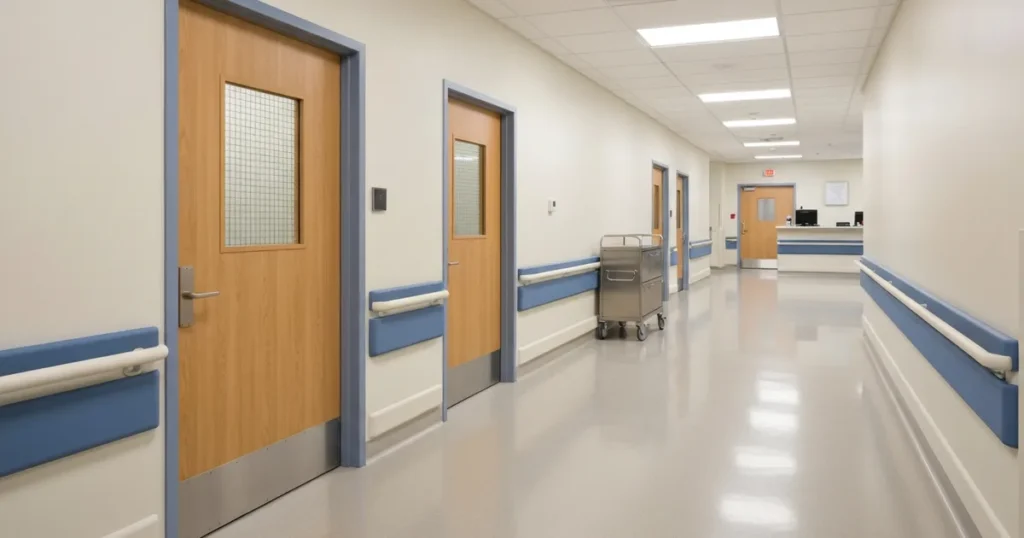
Healthcare door performance is roughly 80% hardware and 20% door slab. The door is a piece of steel. The closer, hinges, lockset, and stops are what determine whether it passes annual inspection. The healthcare door hardware guide covers the seven hardware categories that matter.
The short version:
| Component | Healthcare-grade choice | Why it matters |
|---|---|---|
| Closer | LCN 4040XP or Norton 7500 (heavy-duty cast iron) | Survives 5 million cycles, ADA-compliant low-force adjustment |
| Hinges | Continuous geared (Markar, Roton) | No sag, no exposed pin (ligature) |
| Lockset | ANSI Grade 1 mortise | Privacy indicators, key override, 25-year cycle test |
| Latch | Self-latching with full strike engagement | Required by NFPA 80 for fire doors |
| Kick plate | 16-gauge stainless, 10″ or 12″ tall | Survives gurney and cart impact |
| Glazing | Fire-rated ceramic vision lite | 60–90 minute rating with view to corridor |
| Smoke seal | Pemko silicone smoke gaskets | Required for smoke-rated assemblies |
For deeper detail on any of these components, see the door hinges guide, the door closers page, or the commercial door locks page.
Codes and standards governing healthcare doors
Specifying a healthcare door without understanding the code framework is how facilities fail Joint Commission survey. Four documents govern almost every Ohio healthcare door:
- NFPA 80 — Standard for Fire Doors and Other Opening Protectives. Annual inspection requirement. We perform these inspections statewide. See our fire-door inspection checklist.
- NFPA 101 — Life Safety Code. Means of egress, occupancy classifications, smoke-zone separation.
- FGI Guidelines — Guidelines for Design and Construction of Hospitals. Door widths, swing direction, infection-control measures (ICRA), behavioral-health door specs.
- ADA Standards (2010) — 32″ clear opening, 5-pound max opening force, 5-second minimum closing time.
Ohio also follows the Ohio Building Code and the Ohio Health Care Facility licensure rules, both of which incorporate the NFPA standards by reference.
Why Ohio facilities work with Prime Door
National manufacturers like Stanley Access, ASSA Abloy, and Horton make excellent doors. They don’t show up to your job site, do an as-built measurement, coordinate with the GC, or come back for warranty service. We do.
- 25+ years serving Ohio commercial buildings, headquartered in Youngstown
- NFPA 80 fire-door inspections performed across Ohio
- Integrated supply and install — one vendor for the door, frame, hardware, glazing, and labor
- Direct relationships with Ceco, Mesker, Steelcraft, LCN, Norton, Sargent, Markar, and the major sliding-door OEMs
Frequently asked questions about hospital and healthcare doors
What doors are used in hospitals?
Most Ohio hospitals use a mix of hollow-metal corridor doors (20-, 45-, or 90-minute fire-rated), wood patient-room doors, automatic sliding doors at ICU and OR entrances, lead-lined doors in imaging suites, and anti-ligature doors in behavioral-health units. The exact mix depends on the facility’s clinical mix and the local fire marshal’s interpretation of NFPA 80 and 101.
What do the colors mean on hospital doors?
Hospital door color coding is facility-specific and not standardized nationally. Many facilities use color stripes or door-frame paint to indicate function: red for fire-rated assemblies that must remain closed, blue for patient rooms, yellow for caution areas like radiation or isolation rooms, and green for means-of-egress exits. Always check your facility’s wayfinding and infection-control signage standard before specifying color.
What are the five most common healthcare door types?
The five most common healthcare door types are: (1) hollow-metal fire-rated corridor doors, (2) solid-core wood patient-room doors, (3) automatic sliding ICU and OR doors, (4) anti-ligature behavioral-health doors, and (5) lead-lined imaging or radiology doors.
Does Stanley Access make hospital doors? Do you install Stanley doors?
Yes. Stanley Access (now part of Allegion) makes one of the most-installed automatic sliding hospital door systems in the U.S., including the Dura-Glide, Dura-Care, and Magic-Force product lines. Prime Door installs and services automatic sliding doors in Ohio for projects where these systems are specified. We also work with Horton Automatics, ASSA Abloy / Besam, and Nabco for sites that already have those systems installed.
What hardware is recommended for outpatient clinics and medical office buildings?
Outpatient and medical-office buildings have lighter cycle counts than hospitals, so you can typically use ANSI Grade 2 mortise locks, ball-bearing hinges, and standard-duty closers. The entrance and any code-required exits should still be Grade 1 with continuous hinges. Avoid lever-style residential hardware. Medical office buildings still need ADA-compliant operating force and 32″ clear opening.
What hardware is used for securing ICU or critical-care unit access points?
ICU access typically combines automatic sliding doors with electromagnetic locks, badge readers or wave-switch activation, and fail-safe electrification (door unlocks on power loss for life safety). The specific lock and access-control reader is usually selected by the facility’s security integrator. We coordinate the door, frame, and electric power transfer (EPT) hinge.
How do you specify a healthcare door for a renovation versus new construction?
For new construction, you spec from the architect’s door schedule and the fire-protection plan. For renovation, we send a measure-up tech to verify rough-opening dimensions, existing frame condition, and what fire-rating label can be reused versus replaced. Renovation usually requires a full assembly replacement (door, frame, and hardware) to maintain the fire-rating chain. You cannot mix a new door into an old frame and keep the original label in most cases.
Are healthcare doors inspected annually?
Yes, by law. NFPA 80, referenced by the Ohio Building Code and the Joint Commission, requires annual inspection of every fire-rated door assembly in a healthcare occupancy. Our Ohio fire-door inspection checklist covers what’s required.
Get an Ohio healthcare door quote
Tell us your facility type (hospital, surgery center, clinic, behavioral-health unit, dental practice), the project (new construction, renovation, single-door replacement, fire-door inspection), and your timeline. We respond within 24 hours.
- Phone: (330) 754-2225
- Online quote builder — upload a door schedule, get a budgetary number same-week
- In-person site visit available across Ohio
Prime Door Inc. — Youngstown, Ohio. 25+ years supplying and installing commercial doors for Ohio hospitals, surgery centers, and clinics, with code-compliant healthcare door assemblies.